“The Advocate" Newsletter Archive
SHPO Rehabilitation Tax Credits
Applying for National Register Status
Preservation Tips & Techniques
From the Preservation Community


NATIONAL REGISTER DISTRICT EXPANSION
In 2025, the New York State Historic Preservation Office (NYSHPO) identified a collection of buildings and landscapes east of Lincklaen Street as historically significant and eligible for listing on the State and National Register of Historic Places. These roughly 200 properties — modest, beautiful, and deeply woven into Cazenovia's story — are being proposed for inclusion in an expansion of the existing National Register Historic District.
The nonprofit organization Cazenovia Heritage is coordinating and sponsoring the nomination application on behalf of the neighborhood and its property owners.
A Little Background
Cazenovia already has a proud history with the National Register. The existing district was listed on the New York State and National Register of Historic Places in 1985–86 and encompasses much of the downtown business district and residential streets west of Chittenango Creek, including the Albany Street Historic District (listed in 1978). Together, these areas represent the historic commercial core of the village, its principal civic and cultural buildings, and the homes of Cazenovia's middle and upper classes during the nineteenth and early twentieth centuries.
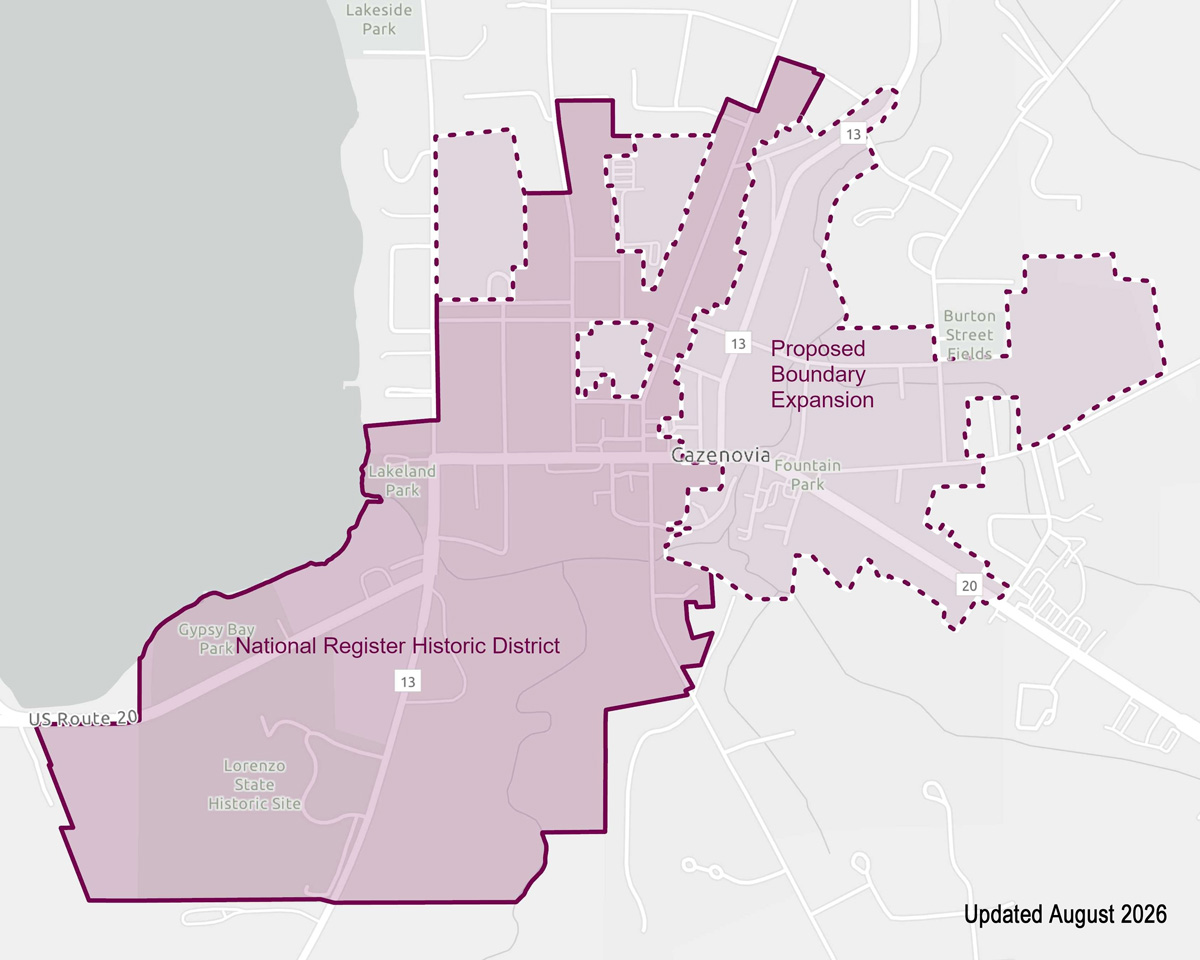
The proposed boundary expansion would extend the boundary to include neighborhoods east of Lincklaen Street — areas that share the same rich historical context as the existing district, but are characterized by the more modest homes of Cazenovia's working-class and middle-class residents of the same era. Their story is an equally important part of what makes this community whole.
What Does This Mean for You?
Simply put: this is an honor, not a regulation
Listing on the National Register of Historic Places is the country's highest honor that recognizes the architectural significance of the buildings and their historical significance in the development of the community and state. It places NO restrictions on what you can do with your property. You are free to repair, renovate, update, or sell your home exactly as you could before. No one will tell you what you can or cannot do. There are no requirements for review, consultation, or notification of any kind. Conversely, it provides no protection from future changes.
This is also not an expansion of the Village's locally designated Historic District. A local historic district can place limitations on exterior changes and require review by the Village Historic Preservation Committee — this project does not do that. The two programs are entirely separate, and inclusion in the National Register does not require inclusion in a local district.
So What Are the Benefits?
- Recognition and pride. Your neighborhood will be formally acknowledged for its architectural and historical significance at the state and national level — a distinction your community has earned.
- Potential tax credits. Primary residences within a qualifying census tract and commercial properties listed on the National Register may be eligible for historic rehabilitation tax credits if you choose to undertake qualifying renovation work. This is an opportunity, never a requirement.
- Community and economic vitality. The existing district has helped raise awareness of Cazenovia's architectural heritage, promoted civic pride, and supported local tourism and the economy. This expansion continues that legacy.
About Cazenovia Heritage
Cazenovia Heritage is a community organization committed to conserving the area's cultural resources — its historic architecture, neighborhoods, sites, and objects that give Cazenovia its distinctive character and sense of place. The organization is made up of engaged local residents and professionals in the fields of architecture, historic preservation, and land use, and believes that honoring Cazenovia's past is essential to its future vitality. Have a look at the 'About Us' page on this website to learn more about who we are and what we do.
What Happens Next / Project Timeline
During late May and June 2026, field researchers will be walking and driving through the project area to photograph and document properties. They will work from public sidewalks and streets only and will not enter private property.
Come to Our Public Meeting
We want to hear from you and answer your questions. A public meeting will be held at the Cazenovia Public Library on Wednesday June 10 from 6:30-7:45 pm. If you would like to hear more about the National Register boundary expansion process, or if you have questions or comments, please join us!
Get in Touch
Have questions or want to learn more? We would be happy to speak with you about this boundary expansion. Contact us: info@cazheritage.org
Frequently Asked Questions
What is a National Register of Historic Places Historic District?
A National Register historic district is a significant concentration of sites, buildings, structures, or objects that are united historically or aesthetically by their plan or physical development. The properties within a district are considered historically significant together because they reflect broad patterns of history, represent a particular architectural style, or are associated with important people or events — or some combination of all of these. This project seeks to expand Cazenovia's existing National Register district to include neighborhoods predominantly east of Lincklaen Street, in recognition of their architectural and historical significance.
How is a National Register Historic District different from the Village Historic District?
This is perhaps the most important distinction to understand. A National Register listing places no restrictions on property owners — it is an honorary designation. The only rare exception is if a project utilizes state or federal funding or requires state or federal permitting. A National Register listing does not restrict a private individual from altering or even demolishing their property.
A locally designated historic district — such as the Village Historic District — is a different program entirely, and can place conditions on a listed property, such as requiring historic commission review of proposed exterior changes. This project does not expand the Village's locally designated Historic District, and properties in the expanded National Register district will NOT be subject to review by the Village Historic Preservation Committee.
Will designation mean that someone can tell me what I can and can't do with my property?
No.
What are the benefits of having my property listed on the National Register?
Listing on the National Register is first and foremost a recognition of significance — an honor acknowledging that your property contributes to local, state, or national history. Beyond that, there are potential financial benefits: primary residences located in a qualifying census tract and commercial buildings on the National Register may be eligible for historic rehabilitation tax credits if you choose to undertake qualifying renovation work. Commercial properties also are eligible for federal historic rehabilitation tax credits regardless of census tract status.
There may be some protection of your property if State or Federal monies are involved in a project.
What grant money or tax credits are available to property owners?
Grant funding is generally not available directly to homeowners or businesses, but primary residences and commercial properties may be eligible for historic rehabilitation tax credits (see above). These credits are available to those who choose to pursue qualifying rehabilitation work and are never a requirement of listing.
Does being in a National Register Historic District place any limitations on my property?
No. Listing in the State or National Register of Historic Places does not place any restrictions or requirements on private property owners. You may do with your property as you wish, within the framework of existing local laws and ordinances — the same framework that applies to every property owner in the Village today.
Will this make it more expensive or cumbersome to repair, maintain, or upgrade my home?
No. National Register listing does not impose any requirements for consultation, notification, or approval of any kind. You may repair, renovate, or upgrade your home exactly as you would today.
Is this a step toward being included in a local historic district?
No. A local government can change the boundaries of its local historic district independently of the National Register, and the two programs have no formal connection. This project seeks only to recognize and honor the significance of the areas east of Lincklaen Street in Cazenovia. It does not expand the Village's locally designated Historic District and would not subject any properties to review by the Village Historic Preservation Committee.
Once the neighborhood surveys are completed, will the area automatically be listed on the National Register?
No. While SHPO has determined these neighborhoods are eligible for listing, they still require substantiation through documentation, photographs, and historical research. After that is compiled with a formal application, residents will be contacted by SHPO as to whether they support the application. The application then undergoes a formal evaluation by the NYS Office of Preservation. If favorable, the application is then submitted to the US Deptartment of Interior for further evaluation and final approval.
How has the existing National Register Historic District impacted the Village?
Since its listing in 1985–86, the existing district has increased local awareness of Cazenovia's architecture and history, with many property owners taking pride in their role as stewards of historically significant places. The designation has also helped promote heritage tourism, contributing to the local economy and reinforcing Cazenovia's distinctive sense of place.
How did the boundary expansion area contribute to Cazenovia's development?
When Cazenovia was founded, the focus of settlement was on the western end of the Village and the Village core. But the growth soon pushed east. First was the creation of industries along the Chittenango Creek of which the 1808 Wool Factory, Atwell Mills, American Lock Company, Die Press Company buildings still stand. Further up the creek were the paper mill, window sash and harvester factories. These industries supplied jobs and created the need for housing. As the population demanded more services, those who could provide them built homes and settled in these neighborhoods. Census records show that the occupations of people living in these neighborhoods included: grocery owners, cabinet makers, clock makers, teachers, blacksmiths, dressmakers, tailors, house painters, wagon makers, merchants, shoemakers, accountants, lawyers, and police officers, as well as day laborers who supported the extensive farms in the Town. This socio-economic growth built a middle-class allowing Cazenovia to endure through the western migration, the Civil War, and market "panics." Many of today's current residents live in the homes of these early Cazenovians.
What will the field researchers be doing in the neighborhood?
During late May and June 2026, representatives will be walking and driving through the project area to photograph and document properties as part of the nomination application process. They will work only from public sidewalks and streets and will not enter private property..
Why should I support expanding the National Register district?
Once listed, there is no change to what you currently can or cannot do with your property. You may potentially become eligible for tax credits on qualifying renovations. And you and your neighbors will share in the honor of having your community's history formally recognized at the state and national level — a distinction that Cazenovia's east side neighborhoods have long deserved.
LINK TO LARGER MAP
Cazenovia Heritage
P.O. Box 103 • Cazenovia, NY 13035
EMAIL info@cazheritage.org
©2026 Cazenovia Heritage and Matai House Studio (web design)